Quick summary: Additive manufacturing, often called 3D printing, builds parts layer by layer from a digital 3D model. Additive manufacturing jobs include preparing digital files, running industrial printers, choosing materials, and finishing and inspecting printed parts. You don’t need a four-year degree, and industry certifications can help you show employers what you know.
What is additive manufacturing?
Here’s how the National Institute of Standards and Technology defines it. Additive manufacturing is “the process of joining materials to make objects from three-dimensional (3D) model data, usually layer by layer.” Most people know it as 3D printing.
Traditional machining starts with a block of material and cuts away what isn’t needed.
Additive manufacturing works the other way around.
| Traditional machining | Additive manufacturing | |
|---|---|---|
| How a part is made | Material is cut away from a solid block | Material is joined layer by layer from a 3D model |
| Where it starts | A block of raw material | A digital 3D model file |
| Where it shines | Large runs of the same part | Small batches of custom parts and intricate shapes |
What do additive manufacturing jobs involve?
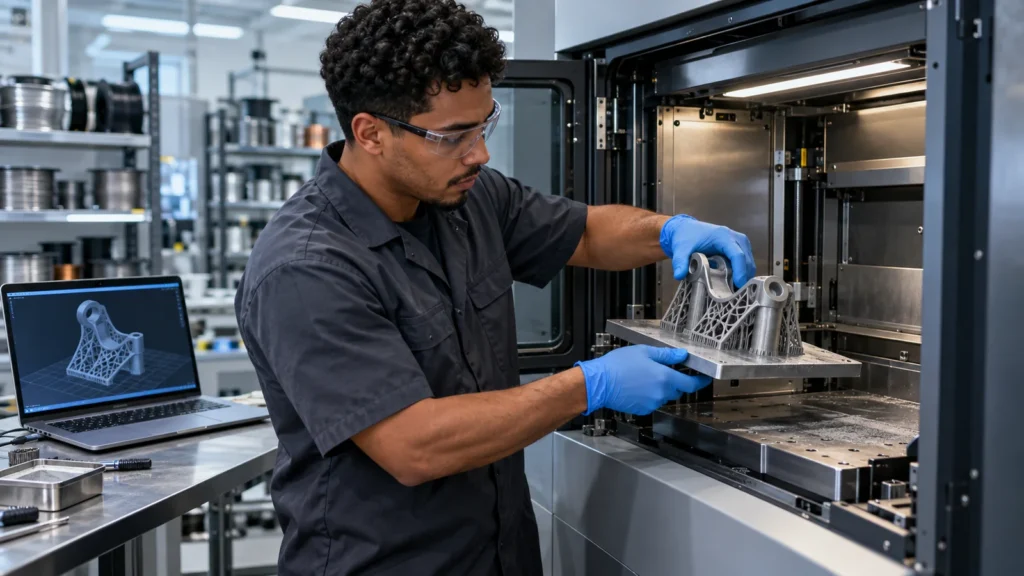
An industrial 3D printer doesn’t run itself. People handle every stage of the work:
- Preparing the build. Setting up the digital model and the print settings so the part comes out right.
- Running the machines. Loading materials, starting builds, and monitoring them.
- Choosing materials. Matching the plastic, metal, or other material to what the part needs to do.
- Post-processing. Removing supports, cleaning, curing, and finishing parts after they print.
- Inspecting quality. Checking that each part meets its specifications.
- Working safely. Handling materials and equipment by the rules.
Job titles vary by employer. Search for additive manufacturing technician, 3D printing technician, and machine operator to see the full range of 3D printing careers.
What skills do you need for additive manufacturing jobs?
The certification exams in this field show what employers expect people to know. SME’s Certified Additive Manufacturing Technician (CAMT) exam covers:
- The seven additive manufacturing technologies
- Additive manufacturing processes
- Material selection
- Post-processing
- Basic safety guidelines
Computer skills matter too, because every part starts as a digital file. So do the basics of measurement and quality checks you’d use anywhere in manufacturing.
How to get an additive manufacturing job
You don’t need a four-year degree to start. SME lists three backgrounds that qualify someone for its technician certification:
- A two-year associate degree in additive manufacturing
- Current enrollment in a college program
- One or more years of working experience in a manufacturing-related field
SME also offers a Certified Additive Manufacturing Fundamentals (CAMF) credential. Hands-on training on real equipment ties it together, so you’ve run a build from start to finish before your first day.
Train for additive manufacturing with Illuminate STEM
Illuminate STEM includes Additive Manufacturing in its Workforce Certification Pathways for learners ages 16 and up. The pathways also cover robotics, industrial automation and PLCs, drones and FAA Part 107, cybersecurity and IT, and welding.
Thinking about more than one pathway? Read about how to become a drone pilot. See all our programs.
Frequently asked questions
Is additive manufacturing the same as 3D printing?
Yes, in most conversations. Additive manufacturing is the industry term for building parts layer by layer from 3D model data, which most people call 3D printing.
Do you need a degree for additive manufacturing jobs?
Not a four-year degree. SME’s technician certification accepts candidates with a two-year degree, current college enrollment, or one or more years of manufacturing experience.
What certifications are there for additive manufacturing?
SME offers the Certified Additive Manufacturing Fundamentals (CAMF) and the Certified Additive Manufacturing Technician (CAMT) credentials.
Start training for a 3D printing career
If you’re 16 or older and want to build things for a living, additive manufacturing is a strong place to start. Explore Illuminate STEM’s Workforce Certification Pathways or email info@illuminatestem.org with your questions.