Quick summary: You can add a robotics curriculum without hiring a new instructor by training a teacher you already employ. Physics, engineering, computer science, and technical trades teachers already have the foundation. Pair them with a ready-built curriculum, the equipment it runs on, and ongoing instructor support. The hiring search is the slowest part of launching a pathway, and skipping it keeps your launch date intact. This guide covers a different route: building the pathway around a teacher you already have.
Where new robotics curriculum plans get stuck
Your board approved the robotics pathway. The budget’s set. Then the job posting sits open for a semester, and the launch date slides.
That’s the point where most new pathways stall. It isn’t the equipment or the funding. It’s the instructor. In the 2020-21 school year, 31% of public schools with open CTE teaching positions had trouble filling them or couldn’t fill them at all. That figure comes from the National Center for Education Statistics and is summarized in ACTE’s 2024 brief on CTE staffing.
Why is it so hard to hire a robotics teacher?
The people who know industrial automation already have well-paid jobs using it. The Bureau of Labor Statistics puts median pay for electro-mechanical and mechatronics technicians at $73,900 as of May 2025. A district posting has to compete with that.
There’s also a certification hurdle. A technician with years on a factory floor usually doesn’t hold a teaching certificate. Many states offer alternative routes for industry professionals, but those take time. They don’t close the pay gap either.
So the search runs long. And the candidates who do apply rarely bring both skills you need: automation knowledge and classroom management.
The robotics teacher you need may already be on your staff
Most districts already employ someone who can lead an introductory robotics course with the right support. Look at teachers in these areas:
- Physics and engineering. They already teach forces, circuits, and the design process.
- Automotive, welding, or agricultural mechanics. They already run hands-on labs with real equipment and real safety rules.
- Computer science. They already teach the programming logic robots run on.
- Any teacher coaching a robotics or STEM club. They’ve already shown the interest, and students already follow them.
These teachers don’t need to arrive as automation experts. They need three things: a complete curriculum, equipment that matches it, and training that continues past the first workshop.
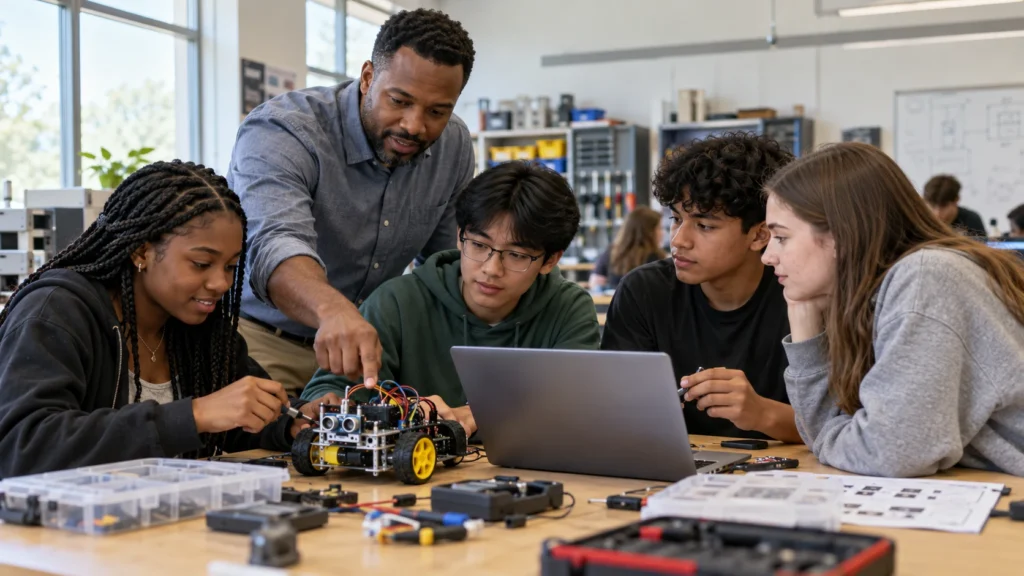
Here’s a simple example. A physics teacher who coaches the school’s robotics club takes on an introductory automation course. She completes instructor training over the summer and teaches from a ready-built curriculum in the fall. When a lab doesn’t work as planned, she has someone to call. The district fills the pathway’s first course without posting a job.
What should a complete robotics curriculum include?
An equipment vendor can ship you robots. That’s not the same as a pathway. Use this table to check what a provider covers and what your staff would have to build themselves.
| Component | What it covers | What to ask the provider |
|---|---|---|
| Curriculum | Lessons, labs, assessments, and pacing for each course | Is it aligned to your state’s CTE standards, and who keeps it updated? |
| Equipment | The robots, controllers, and lab hardware the lessons are built around | Is equipment included, and who services it when something breaks? |
| Instructor training | Preparation and support for the teacher delivering the course | Is training ongoing, or is it a single session before launch? |
| Employer connections | Local companies that host visits, mentor students, or hire graduates | Which employers in your area are already involved? |
| Outcome reporting | The data your board and funders ask for | What gets tracked, and how often do you receive it? |
| Grant support | Help finding funding and meeting its compliance rules | Will they help with applications and reporting, or only point you to grants? |
If a provider can’t answer the training and reporting questions, plan on your CTE office covering those gaps.
How to structure a robotics pathway across grade levels
A pathway isn’t one elective. It’s a sequence of courses that moves from broad to specific and ends in a credential. That’s also how federal Perkins V law describes a CTE program of study, which matters when you go after Perkins funds.
A common four-level structure looks like this:
- Introduction. Robotics fundamentals, lab safety, and basic programming, usually in 9th or 10th grade.
- Core skills. Automation, sensors, and controls.
- Credential course. An advanced course built around an industry-recognized certification.
- Work-based learning. Employer site visits, mentoring, or internships.
You don’t have to launch all four levels at once. Open the introductory course, enroll a cohort, and add the next level as that cohort moves up. Your instructor’s experience grows at the same pace as the pathway.
Before you lock the sequence, check it against your state’s approved programs of study and certification lists. A course that doesn’t fit an approved program is harder to fund and harder to report.
Questions to ask before choosing a robotics program partner
- Who teaches the course, and what training do they get before the first day of class?
- What happens when equipment breaks in the middle of a semester?
- Which certifications can students earn, and are they on your state’s approved list?
- Which employers are involved, and what have they committed to?
- What outcome data will you receive for board presentations and grant reports?
- What does year two cost compared with year one?
The last question gets skipped most often. A pathway that’s affordable to launch but expensive to sustain will end up back in front of your board.
How Illuminate STEM works with school districts
Illuminate STEM partners with school districts to deliver technology career pathways in robotics, advanced manufacturing, and emerging technology. We provide the curriculum, the equipment, and the training for your instructor. Your district keeps the students, the teacher relationships, and the community connection.
Partnerships also include grant funding and compliance support, employer connections for student career opportunities, and outcome reporting built for board presentations. You can see current offerings on our programs page or learn more about Illuminate STEM.
Frequently asked questions
Does a robotics teacher need an engineering background?
No. Teachers from physics, computer science, or technical trades can lead an introductory robotics course when they have a complete curriculum and ongoing training. Advanced courses benefit from deeper training or an industry partner in the classroom.
Can a district start with one robotics course?
Yes. Open the introductory course first and add a level each year. That spreads the cost and gives your instructor time to build experience before the advanced courses begin.
How do school districts pay for a robotics curriculum?
Common sources include federal Perkins V funds, state CTE grants, and partnerships with local employers. Your CTE director can confirm which funds apply to your approved programs of study.
What’s the difference between a robotics club and a robotics pathway?
A club is an extracurricular activity. A pathway is a sequence of for-credit courses that builds toward an industry certification or a job.
Plan your district’s robotics pathway
If your robotics pathway is approved but stuck on staffing, start with the teachers you already have. Talk with Illuminate STEM about a district partnership and get a curriculum, equipment, and training plan built around your current staff.