
If you like figuring out why a machine stopped, you already have the instinct behind robotics technician skills. Safety, wiring, troubleshooting and robot programming can all be learned, and you can start training for the job at 16. This guide walks you through what technicians do on a normal shift and how to take your first step.
I spent years installing industrial robots in large manufacturing plants, and the robots almost always worked. The harder question came after the install, when a plant needed someone on the floor who could program the robot, maintain it and get it moving again when it faulted at the worst possible time. There still aren’t enough of those people around, and that’s the job of a robotics technician.
If you’re 16 or older and you’d rather fix a machine than read about one, here’s what the work takes and how you can start training through Illuminate STEM’s Workforce Pathways and Certifications, online from Dallas, Detroit or anywhere else.
What does a robotics technician do?
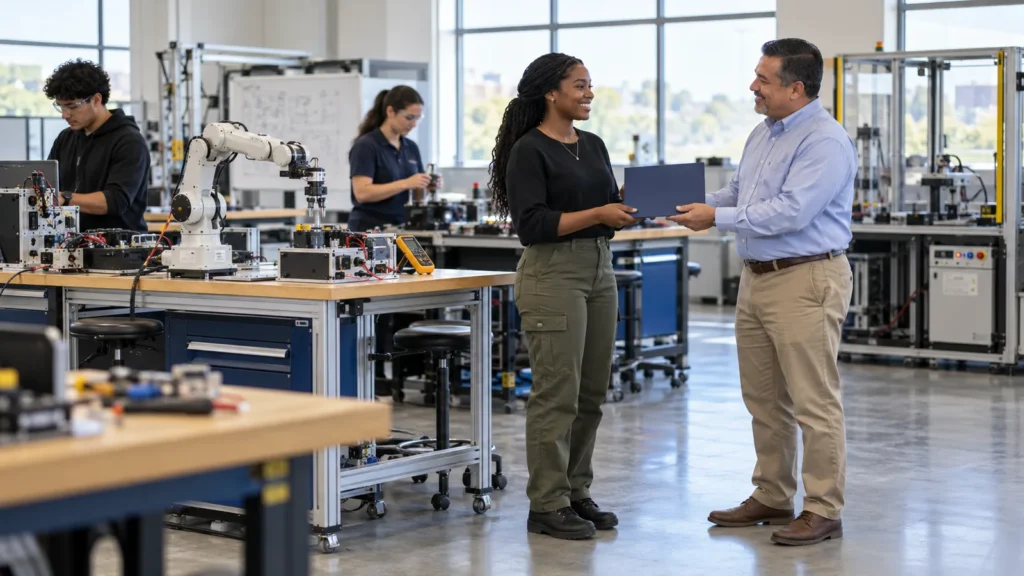
The U.S. Bureau of Labor Statistics groups this work with electro-mechanical and mechatronics technicians, who “operate, test, and maintain electromechanical or robotic equipment.” In practice, a shift might include checking a robot cell before production starts, tracking down why an arm stopped mid-cycle, swapping a worn gripper or sensor, and adjusting a program so the robot places a part a little to the left.
Here’s how BLS describes the field:
| Measure | Electro-mechanical and mechatronics technicians |
|---|---|
| Median annual pay | $73,900 (May 2025) |
| Job outlook, 2025 to 2035 | 3 percent, about as fast as average |
| Openings each year, on average | About 1,400 |
| Typical entry-level education | Associate’s degree or a postsecondary certificate |
The robotics technician skills employers look for
Safety around moving equipment
Industrial robots are strong and fast, so every good program starts with lockout procedures, safe zones and how to work near a cell that could move. It’s the first thing you’ll learn, and it should stay the habit you never skip.
Mechanical and electrical basics
You’ll work with motors, gears, pneumatics, sensors and wiring. Nobody expects you to know all of it on day one, but you do need to be comfortable with tools and curious about how the parts fit together.
Troubleshooting
This is the skill that separates a good technician from a great one. When a robot faults, you work the problem one step at a time, asking what changed, what the error code says and what you can safely test, and you stay calm while a line waits on you.
Robot programming
Technicians teach robots new positions and paths, often with a handheld teach pendant. Many robots also take signals from programmable logic controllers, so it helps to understand how a PLC runs the rest of the line.
Reading manuals and diagrams
Wiring diagrams, manuals and maintenance logs tell you how a system is supposed to behave, and reading them well can save you hours on the floor.
How do you start robotics technician training?
Most employers want proof that you’ve learned the skills before they hand you a teach pendant. An industry certification gives you that proof, and you can earn one before or alongside college.
Illuminate STEM’s Robotics Technician and Robot Programming certification path is open to students 16 and older and to adults. Courses run online through a certifying partner, and you get mentorship from people who’ve done this work, hands-on technical experience and help mapping your next step toward an internship, apprenticeship or first job. If you’re weighing which credential is worth your time, start with what makes an industry-based certification worth earning.
Frequently asked questions
Do I need a college degree to become a robotics technician?
Not always. BLS says these technicians typically need either an associate’s degree or a postsecondary certificate, and an industry certification can help you show employers what you know.
How old do I need to be to start training with Illuminate STEM?
The certification paths are open to students 16 and older and to adults. Students ages 12 to 16 can start with Foundation Learning Pathways.
Is a robotics technician the same as a robotics engineer?
No. Engineers design robotic systems, while technicians install, program, maintain and repair them on the floor.
Start your robotics technician path
If you want to work with robots for a living, the skills employers ask for are a good place to begin. Tell us you’re interested in the Robotics Technician path and we’ll help you map your first step, or email info@illuminatestem.org with your questions.